I usually bring a 20,000 mAh powerbank on all my flights. It saves me a lot because I take pictures and videos frequently, which consumes my phone battery life quickly. Having a reliable powerbank ensures that I can keep my devices charged and capture all the memorable moments during my travels.
Traveling with Powerbanks: What You Need to Know
As technology continues to evolve, travelers increasingly rely on powerbanks to keep their devices charged during flights. However, recent incidents have prompted several airlines to implement stricter regulations on the use of powerbanks onboard. Here’s a look at some airlines that monitor and restrict powerbank usage, ensuring passenger safety.
- Why the Restrictions?
- Airlines Implementing Restrictions
- Converting Wh to mAh
- Common Powerbank Capacities
- What Travelers Should Do
Why the Restrictions?
The primary reason for these restrictions is safety. Lithium-ion batteries, commonly found in powerbanks, have been known to cause fires if damaged or improperly handled. A notable incident occurred on Air Busan Flight 321, where a fire caused by a powerbank led to injuries and significant damage to the aircraft. To prevent such occurrences, airlines have started to enforce stricter rules.
Airlines Implementing Restrictions
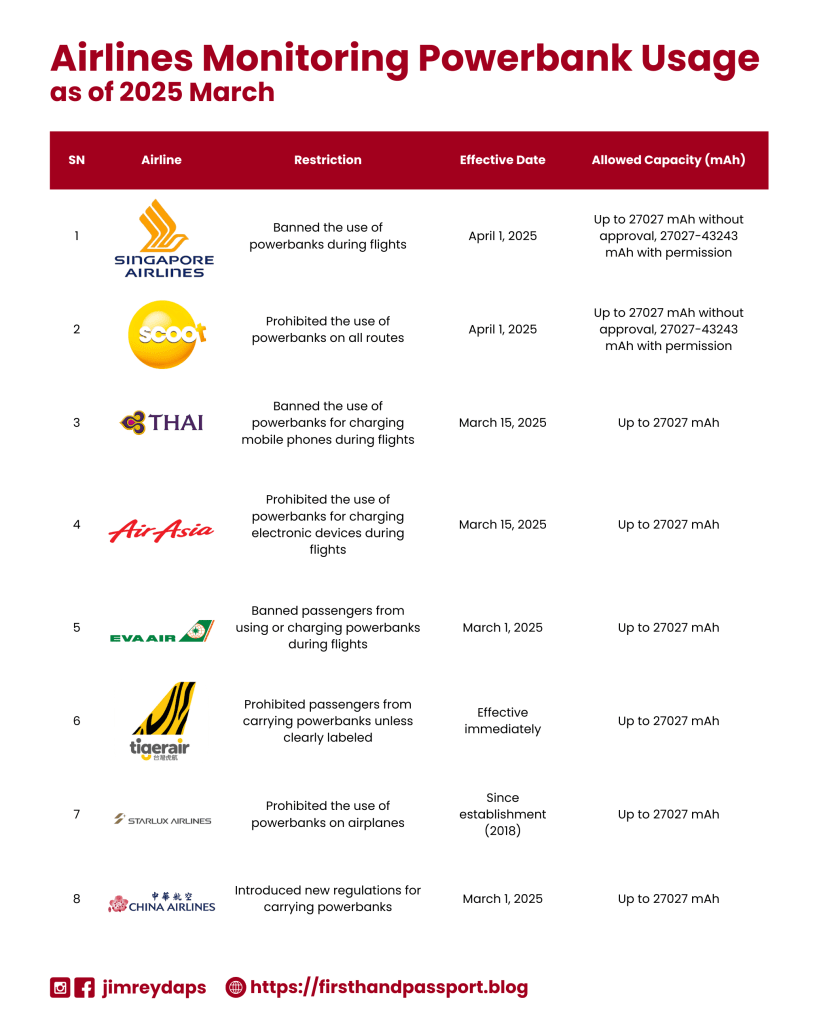
- Singapore Airlines: Effective April 1, 2025, Singapore Airlines has banned the use of powerbanks during flights. Passengers can still carry powerbanks with a capacity of up to 100 Wh without approval and those between 100 Wh and 160 Wh with airline permission.
- Scoot: As a subsidiary of Singapore Airlines, Scoot has also prohibited the use of powerbanks on all routes starting April 1, 2025.
- Thai Airways: Thai Airways has banned the use of powerbanks for charging mobile phones during flights, effective March 15, 2025. Passengers can carry powerbanks in carry-on bags, provided they comply with capacity limits set by the Civil Aviation Authority of Thailand (CAAT) and IATA safety standards.
- AirAsia: Following Thai Airways, AirAsia prohibits the use of powerbanks for charging electronic devices during flights, effective March 15, 2025. The airline permits passengers to carry external batteries with a watt-hour capacity not exceeding 100 Wh.
- Eva Air: Eva Air has banned passengers from using or charging powerbanks during flights, effective March 1, 2025. Passengers are advised to use the AC power outlets and USB ports available at their seats for charging.
- Tigerair Taiwan: Tigerair Taiwan prohibits passengers from carrying powerbanks unless the charger has clearly labeled specifications. The airline advises against using portable batteries during flights.
- Starlux Airlines: Since its establishment in 2018, Starlux Airlines has prohibited the use of powerbanks on its airplanes to enhance flight safety. Passengers can carry powerbanks in carry-on bags in accordance with applicable regulations.
- China Airlines: China Airlines has updated its travel advisory, introducing new regulations for carrying powerbanks from March 1, 2025. Passengers must cover powerbank ports with insulating tape and protective covers or place them in transparent zip-lock bags.
Converting Wh to mAh
Understanding the capacity of your powerbank is crucial for compliance. Here’s a simple conversion formula:
mAh=Wh×1000Voltage (V)mAh=Voltage (V)Wh×1000
For example, if you have a 100 Wh powerbank with a voltage of 3.7V (common for lithium-ion batteries):
100 Wh×1000/3.7 V≈27027 mAh100 Wh×1000/3.7 V≈27027 mAh
Common Powerbank Capacities
Here are some common powerbank capacities and their conversions:
| Powerbank Capacity (mAh) | Powerbank Capacity (Wh) | Airlines Banning Usage |
|---|---|---|
| 5000 mAh | 18.5 Wh | None |
| 10000 mAh | 37 Wh | None |
| 15000 mAh | 55.5 Wh | None |
| 20000 mAh | 74 Wh | None |
| 30000 mAh | 111 Wh | Singapore Airlines, Scoot, Thai Airways, AirAsia, Eva Air, Tigerair Taiwan, Starlux Airlines, China Airlines |
What Travelers Should Do
To ensure a smooth travel experience, passengers should:
- Check Airline Policies: Before flying, review the airline’s policy on powerbanks. Regulations can vary significantly between airlines.
- Carry Properly: Ensure powerbanks are within the allowed capacity limits and are properly labeled.
- Use Alternatives: Utilize the aircraft’s AC power outlets and USB ports for charging devices during flights.
By staying informed and adhering to these guidelines, travelers can enjoy a safer and more convenient journey. Safe travels!
If you found it helpful and would like to show your appreciation, you can buy me a coffee here.
 firsthandpassport
Leave a comment